The Garden after Gaza: Third Meditation
Zone of Indifference
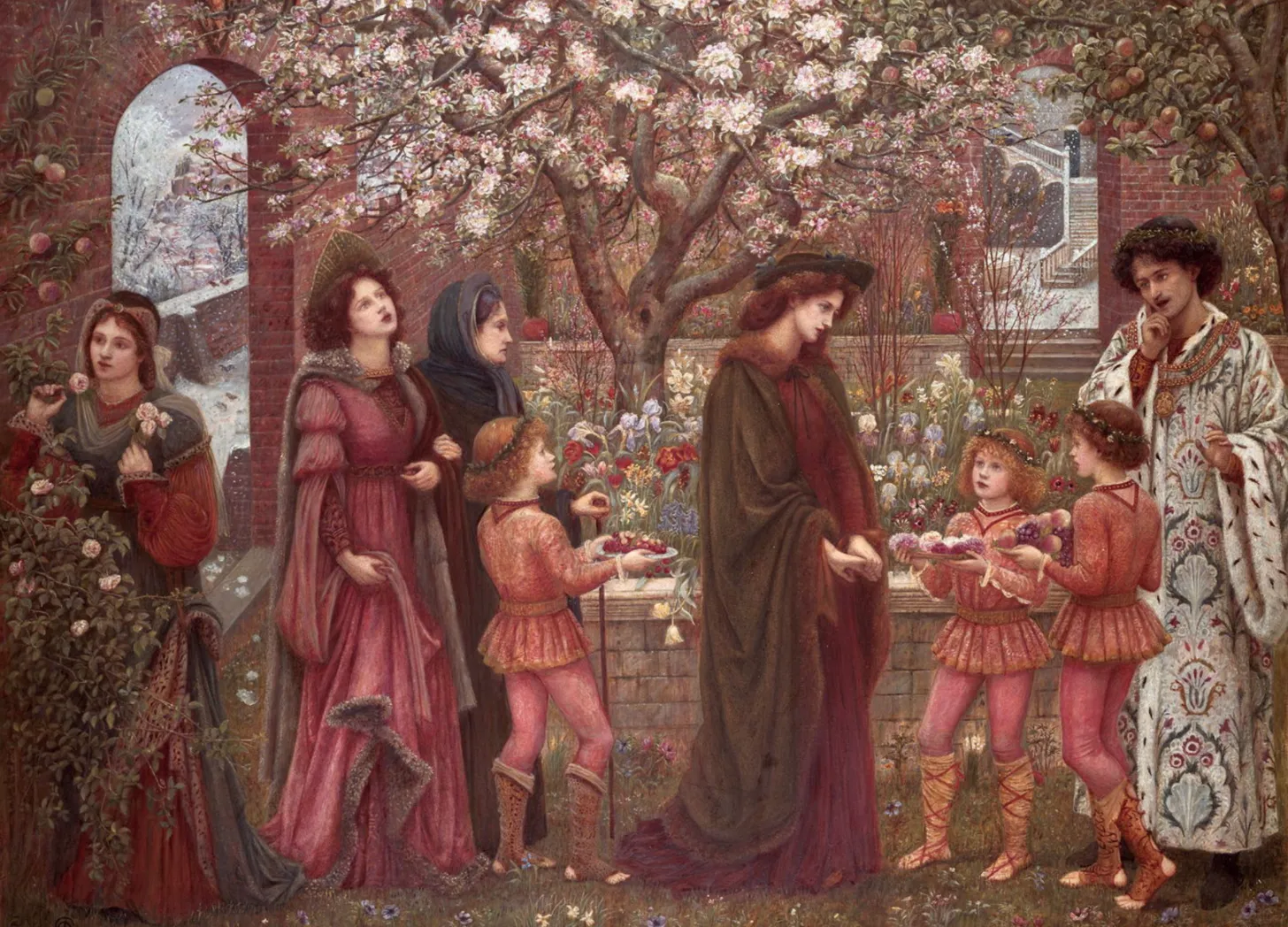
The Enchanted Garden
The words “garden” and “paradise” are etymological synonyms. Both mean “enclosure.” I’ve already written on Mixed Borders about the etymology of the word “garden.” As for “paradise,” the “par” derives from the Greek peri, meaning around or surrounded, as in perimeter, and the “dise” from the Proto-Indo-European root dheigh, an embankment, that comes into the word paradise via the Avestan daēza, meaning “wall.” Within the garden’s walls is paradise: flourishing greenery, safety, peace, plenty, and beauty. On the other side of the wall is an unprotected space of danger, suffering, and death.
The painting above, by pre-Raphaëlite painter Marie Spatalli Spillman, illustrates part of a story in Giovanni Boccaccio’s The Decameron (circa 1350). With the plague raging in Florence, ten highly cultivated people, seven women and three men, flee the death and degradation of the city for an idyllic villa in the Tuscan countryside. There, they while away the hours by eating delicate meals on beautifully set tables prepared by discreet servants, walking around the gracious gardens surrounding the villa, playing the lute, singing, dancing and, most importantly, telling stories. Naturally, these are stories about love, or at least about seduction: cheating wives, dimwitted husbands, cheating husbands, unhappy wives, and so on.
Marie Spatalli Spillman’s painting is of a scene from a tale told by Emilia, a narcissistic young woman, who likes to admire her good looks in a mirror, and dance in front of the other members of the group. Emilia tells the story of a noble lady named Diorina, the wife of a wealthy man, who is pursued by an impressive nobleman, Ansaldo Grandense, famed for his high culture and his skill with arms. Diorina, faithful to her husband, resists Ansaldo’s persistent advances. One day, she decides to put an end to his pursuit by laying down an impossible challenge as the price of her favors:
“I would have this next ensuing January, hard by this city, a garden full of green grass and flowers and flowering trees, just as if it were May; and if he cannot provide me with this garden, bid him never again send either thee or any other to me, for that, should he harass me any further, I shall no longer keep silence, as I have hitherto done, but shall make my complaint to my husband and all my kinsmen, and it shall go hard but I will be quit of him.”
Alas for Diorina, Ansaldo finds a man skilled in the magical art of necromancy who succeeds in creating a lovely May garden during the coldest days of January. Diorina is appalled. Her husband is, understandably, upset when she tells him the bind she is in, but fearing what the necromancer, a man in touch with the dead, might do to them should Diorina default on the deal, he bids her to go to Ansaldo and, if sleeping with him can’t be helped, give him her body but not her soul. When a tearful Diorina shows up in the garden, Ansaldo is surprised that she is there at the behest of her husband. Impressed by this generous gesture, his carnal desire for Diorina turns into brotherly love, and he sends the unsullied Diorina home. The necromancer, in turn, is so impressed by all this self-sacrificing virtue, that he renounces the payment Ansaldo has promised him. So ends this feel-good tale. We do not learn what happens to the garden. Presumably, no longer needed, it disappears in a poof of magic.

One of the first things I thought of when I looked at the wintry scene glimpsed beyond the rich garden’s walls in Spillman’s painting was nuclear winter, the white-ash covered world plunged into sunless lifelessness after the explosion of a nuclear bomb. I grew up in the nuclear age, during the Cold War that ever threatened to morph suddenly into a very hot war. Nuclear winter was a concept that intrigued me as a child, something bitterly cold resulting from something exceedingly hot. It also terrified me: One big blast, and life as we knew it and dreamed it was over. We would all be propelled into the realm of the dead, with no necromancer to summon us back to life.
The trope of a May garden in full flower enclosed all around by winter’s dormancy and of death safely blocked outside enchanted walls that surround a space of flowers, fruit, sweetmeats, soft air and spring blossoms, is a perfect vision of the walled garden, a paradise within and a hellscape without, as people have imagined it for millennia. As a story told within the larger story of The Decameron, the story of the retreat to a country garden paradise of a group of comely men and women from a city turned into a hell on earth of sudden death, rotting corpses, families abandoning their sick loved ones, and the general unraveling of civility into the last consolations of drunkenness, lawlessness and licentiousness, Emilia’s story is a classic example of literary mise en abyme, a story within a story that echos the larger, framing narrative. It is an abyme, or abîme, an abyss, that could go on pulling us deeper and deeper into the same trope within a trope within a trope ad infinitum.
There is no escape from the garden as metaphor.

Zone of Interest
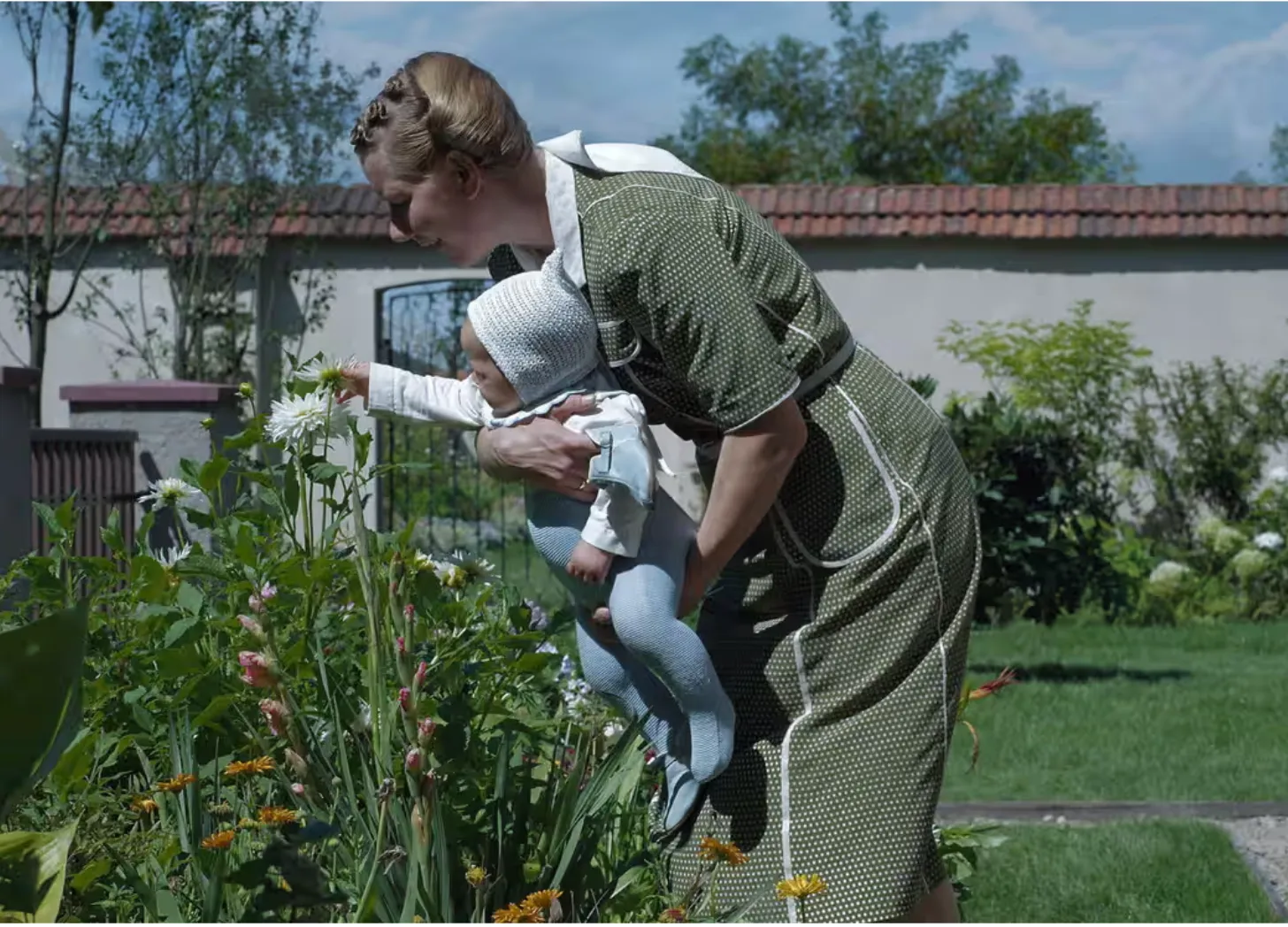
A European garden, perfectly weeded and manicured, a pleasant playground for towheaded children, a pretty setting for garden parties for their parents, situated hard against a human liquidation facility, where masses of people are killed with industrial efficiency, just on the other side of the garden wall: Such is the setting of Jonathan Glazer’s 2023 movie ‘Zone of Interest.’ The movie won the Academy Award for Best International Feature Film in 2024. It is based on the history of Auschwitz, and the completely banal, suburban life Nazi commander Rudolph Höss and his family lived in a villa on the camp compound.
‘Zone of Interest’ is an eerily understated film. We never see what is going on on the other side of the garden wall. We only hear muffled shots, indistinct cries. Slowly we come to understand where the neat little family home that is the setting for most of the movie is situated, and the atrocities happening on the other side of its garden wall.
The young father in his Nazi uniform, or in casual clothes fishing and swimming in a nearby river with his children before they are chased out of the water by a stream of effluent — burnt human remains — flushed out of the camp, is the camp commander, Rudolph Höss. Höss’s post allows his family to enjoy a life they could never have otherwise been able to afford: a manicured garden, the Polish servants who soundlessly clean and serve under pain of death, a lush fur coat for the wife, Hedwig, that had only just recently belonged to a woman far richer than she. In a disquieting scene typical of the unnerving intimacies the movie evokes between the murderers and the murdered, Hedwig, feeling into the pockets of the coat, fishes out a tube of lipstick, opens it and slides some of the color across her lips. In her review of the film, Naomi Klein asks how not to make the connection between this scene and the selfie films of young Israeli soldiers prancing around in women’s lingerie found in the bombed out homes of Palestinians in Gaza. On the banality of evil, she writes:
“Genocide becomes ambient to their lives”: that is how Glazer has described the atmosphere he attempted to capture in his film, in which his characters attend to their daily dramas – sleepless kids, a hard-to-please mother, casual infidelities – in the shadow of smokestacks belching out human remains. It’s not that these people don’t know that an industrial-scale killing machine whirs just beyond their garden wall. They have simply learned to lead contented lives with ambient genocide.
As have too many Israelis. As have too many of the rest of us.

Zone of Indifference
Ambient genocide, journalists and doctors targeted for assassination, people being kidnapped off American streets by masked hoodlums and put into concentration camps, territorial seizure by force with little consequence, the collapse of international law and human rights: There is a lot of evil to process right now, evil in which we are complicit, if only in the name of our still nominally democratic governments, every single day. Many of us have the privilege of tuning out, turning off, and retreating into our still mostly unscathed daily lives as if none of this is happening. Like the Florentine storytellers in The Decameron whose experience of beauty and pleasure in a Tuscan villa’s gardens could not contrast more with the pustular death stalking the city they have fled, we retreat to a paradise of distraction amidst carnage kept out of sight and mind.
‘Zone of Interest’ was the name the Nazi’s gave to the entire area under camp command at Auschwitz. Hedwig and her family, in their perfect garden and neat-as-a-pin house, live in a Zone of Indifference to the atrocities next door. So do most of us.